Over the years, electrically powered
farm equipment has become an
indispensable element of modern
farming. With the widespread use of
electricity on the farm, more emphasis
needs to be placed on using electricity
and electrical equipment safety.
Nationally, approximately 30 to 40 people
a year are electrocuted on farms. A better
understanding of the principles, uses,
and hazards associated with electricity
could have prevented many of these
deaths.
To understand the hazards associated
with electricity, it is important to know the
basic principles of electricity and how
shocks occur. Electricity's basic principles
can be explained with the terms voltage,
current (amperage), and resistance.
Voltage is the force that initiates the flow
of electric charge. The actual flow of
electric charge is called current. The rate
of flow is measured in amperes. Resistance
is based on how much a material impedes the current and
regulates the rate of flow. Electricity
usually takes the path of least resistance.
When the human body becomes part of
this path, the result is electric shock.
Two wires are needed to complete an
electrical circuit--one wire to carry the
current to an electric device, the other to
return the electricity to the power source
and finally to the ground. If the protective
insulation on any of the wires or inside a
piece of electrical equipment is defective,
the current can follow a different path to
ground. By coming in contact with a faulty
electrical object, a person may act as a
conductor to ground and experience a
shock.
Several factors determine the effect a
shock will have on a human body: the
duration of contact, the amperage, the
path the current takes through the body,
and the electrical resistance of the body.
A person standing in water is a better
conductor than a person on dry ground.
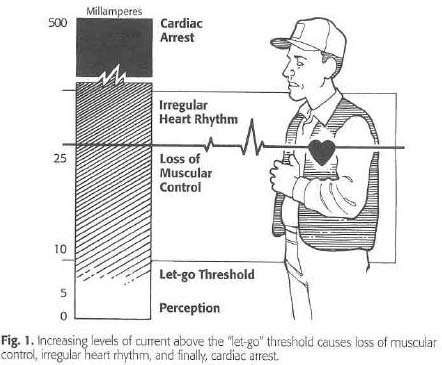
Taken together, these factors can
produce some surprising results. For
instance, the current from a 7 1/2 watt
Christmas tree bulb (60/ 1000 of an
ampere) can kill a person if the current
passes through the heart. Figure 1 shows
the physiological effects of different
current levels.
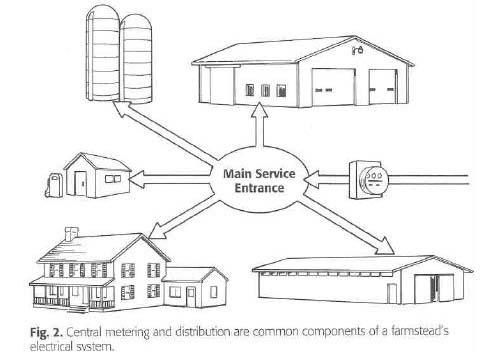
Electricity is brought to a farm from a
power company's supply lines through
the main service entrance. Normally, all
power to the farm is metered at this point.
The main disconnect should be located
here so that all power to the farm can be
manually turned off at one point.
From the main service entrance, wires
lead to each building or area service
entrance through buried or overhead
wires. These service en- trances should
also be equipped with disconnects so
that power can be shut off to one site
without affecting other areas.
The main distribution system on a
farmstead should always be large
enough to accommodate present
demand and future expansion. Proper
installation of the electrical system is
essential for safety. Local codes should
always be followed because their main
purpose is to provide users with safe
systems. If no electric code exists for
your area, the National Electric Code
(NEC) is the minimum standard to follow.
Only qualified electricians should install
electrical systems.
Circuit Protection
Electrical systems have built-in features
to safeguard equipment and wiring from
excessive current. The most common
circuit protection is a fuse. When excess
current flows to the fuse, a portion of it
breaks, cutting power to the circuit. To
restore power, the fuse must be replaced.
A circuit breaker offers the same
protection, but is more convenient. A flip
of a switch restores power after a circuit
breaker has been tripped by an overload.
When a fuse blows or a circuit breaker
is tripped, remember:
- The circuit breaker or the fuse should
never be bypassed because this can
damage equipment or start a fire if
the circuit becomes overheated.
- Never replace a fuse with one that is
larger than that specified for the
circuit. A fuse that is too large will not
protect against an overload, which
can cause a fire.
- Do not replace fuses with pennies,
nails, bar stock, or other objects.
Many electrical fires have been
caused by such substitutions.
Grounding is a necessary safety feature
of every electrical system. It protects
against electric shock, fire, and damage
to equipment and reduces the hazards
associated with lightning. Proper
grounding for both the system and
electrical equipment is particularly
relevant for farmsteads.
System grounding starts at the main
service entrance. The neutral of the main
service is connected either to an all-metal
water pipe or to a metal rod that has
been driven into the ground. These act as
ground electrodes. If a ground rod is
employed, it must be driven deep enough
to always be In contact with moist soil (at
least 10 feet). To ensure continuity of the
ground throughout the system, each
branch service entrance should be
grounded with its neutral wire connected
to the grounded main service neutral.
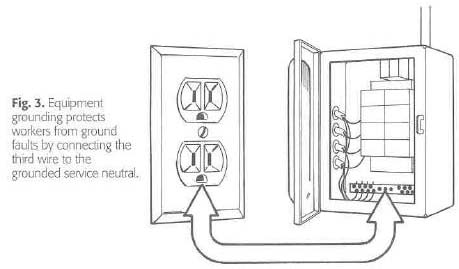
Equipment grounding ensures that a
person who comes in contact with
electrical equipment does not get a shock
because of a ground fault. A ground fault
can occur when wiring connections
become loose or protective insulation is
broken or defective.
When current leaks and electrifies a
metal box or fixture, it follows a
conductive path to complete its circuit. An
equipment ground serves as a conductor
or path of low resistance.
The best way to ground power tools is
to use tools with three-wire power cords
and three-prong plugs. The third wire is
the ground and connects to the system
ground when it is plugged into a properly
grounded outlet. When using an
extension cord, be sure it has a third wire
for grounding. To confirm that
receptacles have maintained their
ground, periodically check them with a
circuit tester. Double-insulated power
tools are also available, offering
protection from ground faults by providing
a layer of insulation between the wires
and the tool's metal casing. Double insulated
power tools are not as
effectively grounded as three-wire tools
because the insulation can fail if it gets
wet.
Any metal, system, or equipment
component that may become electrified
when a fault occurs needs to be
grounded. This includes, but is not limited
to, junction boxes, motor frames, and
fuse boxes. The electrical system ground
does not ground these metallic
enclosures. A qualified electrician should
install all ground connections to make
sure the system functions properly.
Ground fault circuit interrupters (GFCI)
are also used to protect against shocks
from ground faults. A GFCI detects
current leakage at very low levels (as
little as 5 milliamps) and rapidly cuts off
the power. Three types of commonly
available GFCIs are units built into circuit
breakers, units built into receptacles, and
portable GFCIs that plug into any
receptacle.
 Lockouts
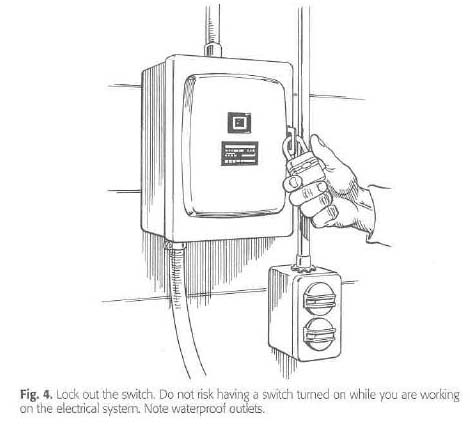
The purpose of a lockout is to prevent
equipment from being accidentally
started and injuring people when it is
being serviced or repaired. When servicing electrically powered equipment,
a lock should always be placed on its
switch. For example, if a silo unloader
needs a repair, a lock on the control box
will prevent the machine from starting
while you are working inside the silo.
 Harsh Farm Environments
Many agricultural facilities have severe
environments that require special
attention when installing and maintaining
electrical systems. Threats to the system
come from a number of sources. The
vapors from
animal waste in confinement housing can
corrode electrical components. High
humidity in milking facilities can rapidly
deteriorate conventional metal electrical
boxes. Physical damage to wiring, boxes,
and light fixtures can be caused by
livestock, equipment, and people. To
protect your assets from fire or the cost of
rewiring, follow these recommendations
when installing your electrical system.
In corrosive and damp environments
- Use underground feeder (UF) electric
cable.
- Make sure all control boxes, light
fixtures, switches, and receptacles
are made of corrosion-resistant
materials.
- Install watertight covers on
receptacles and switches and over
light bulbs.
- Locate the distribution panel away
from severe environments. If a clean,
dry area, such as an office, is not
available, mount the distribution
panel outside.
- Make sure that every electrical
system component or piece of
equipment located outside is
watertight.
- Run conductors through horizontal
conduit and seal the conduit ends so
moisture cannot enter the distribution
panel. When conductors run from a
warm, moist environment to a cold
location, condensation can form and
enter the distribution panel.
- Inside farm buildings, mount wiring
outside of walls to allow continuous
inspection.
In dusty environments (such as grain or
feed handling areas):
- Place protective enclosures over all
light bulbs to protect them from dust
and lessen the fire hazard.
- Use explosion-proof switches. Fire
from an explosion can occur in areas
where fine dusts or harmful, highly
flammable vapors come in contact
with sparks from an electric switch.
In areas where physical damage to the
electrical system by livestock, equipment,
or people is likely:
- Protect circuit boxes by thought- fully
choosing their location. Placing them
around a corner or away from
animals makes the boxes far less
vulnerable to abuse.
- Run conductors in conduit to protect
them from physical damage by livestock.
- Use nonmetallic conduit in corrosive
environments.
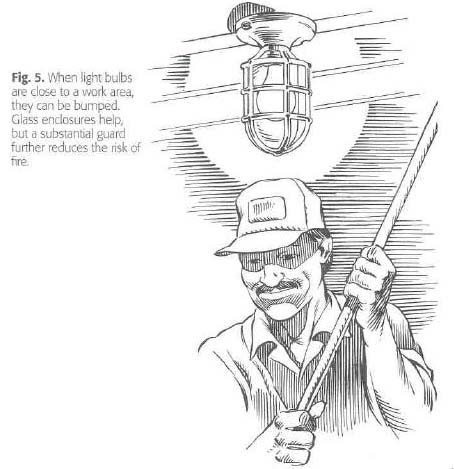
- Place guards over light bulbs located
where they may get struck by
equipment, and use enclosures to
keep moisture and dust out.
- Use only qualified electricians to
repair damage to electrical
installations.
Standby Power
Many farm owners have standby
generators on hand to use during power
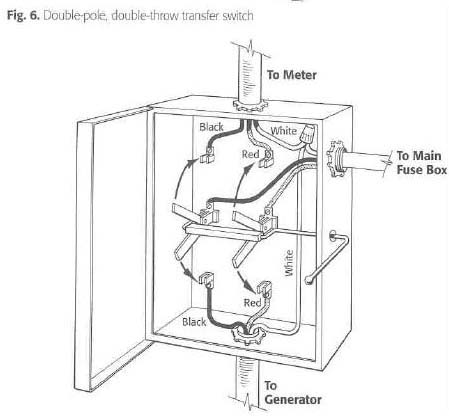
outages. When a standby generator is
installed on single phase systems, it must
be connected to the farm's wiring system
through a double-pole, double-throw
transfer switch (see fig. 6). When the
generator is in use, this switch
disconnects the farm's electric system
from the normal power supply. There are
two reasons why this is important. First, it
prevents the generator from feeding
power to power supply lines where repair
persons may be working. Second, the
normal power supply cannot feed back to
the generator and damage it when power
from the electric utility is restored.
The transfer switch must be installed
so that the generator is no more than 25
feet from the switch. Installation of the
transfer switch should always be
reviewed with the local electric supply
company.
Overhead Power Lines
Numerous electrocutions on farms have
been caused by contact with overhead
wires. Transporting equipment requiring
high clearance underneath low overhead
wires can be especially dangerous.
Fatalities have been attributed to portable
augers coming in contact with overhead
wires. These lives could have been
saved if a few minutes had been taken to
lower the equipment.
Other activities such as pruning trees
or moving irrigation pipe or metal ladders
near overhead wires can also be
hazardous. Low overhead wires are
frequently found in farm- yards and also
farm lanes between fields and roads.
Anyone working in these situations
should be made aware of the dangers
overhead wires present.
Hazards are also associated with
buried service conductors. A person
operating a trencher or excavating
equipment may get electrocuted if the
machine comes in contact with the
underground wires. Keep a detailed map
of all buried power lines to avoid such
accidents.
Electric shock can cause respiratory
paralysis, heart fibrillation, and severe
burns. If the heart stops beating and
breathing has ceased, the victim will
suffer brain damage after four to six
minutes.
It is very important to respond quickly
to an electric shock emergency. The
victim must first be separated from the
source of the shock. The best method is
to cut off the power source. Never touch
a person until he or she has been
separated from the power source, or you
also risk being electrocuted. Send for
professional medical help immediately. If
the victim is not breathing, artificial
respiration must be administered quickly.
When there is no pulse, coronary
pulmonary resuscitation (CPR) should be
started.
If you are alone and are not trained in
administering CPR, you should still
attempt to revive the victim, because this
may be the only chance for survival. Tilt
the injured person's head back, pinch the
nostrils closed with your fingers, take a
deep breath, place your mouth over his
or her mouth and blow. Move your head
away and allow the person to exhale.
Repeat. Position the heel of one hand on
the lower half of the adult victim's
sternum, place your other hand on top of
the first, and press down 1.5 to 2 inches.
Fifteen compressions to two breaths
should be repeated until professional
help arrives.
Proper installation of a farm's electrical
system is essential to electrical safety.
This includes grounding the entire system
and all electrical equipment. Protect the
electrical system and your life by using
only the appropriate fuses and circuit
breakers. Follow local electric codes or
the National Electric Code and hire a qualified electrician
when installing or modifying your
electrical system.
Finally, maintain your system by
promptly repairing any damage or
deterioration. Electrical safety is a critical
component of a productive and safe farm
business.
Power Take-Off Safety
Lightning Protection for Farms
Slow Moving Vehicle Emblems
Safer Farm Environments for Children
Safe Animal Handling
This publication is issued to further Cooperative
Extension work mandated by acts of Congress of
May 8 and June 3 0, 1914. It was produced with the
cooperation of the U.S. Department of Agriculture;
Cornell Cooperative Extension; the New York State
College of Agriculture and Life Sciences, New York
State College of Human Ecology, and New York
State College of Veterinary Medicine, at Cornell
University. Cornell Cooperative Extension provides
equal program
Designer: Dennis E Kulis
Editor: David A. Poland
Illustrations by Jim Houghton
For additional information: call 1-877-257-9777
Cornell Agricultural Health & Safety Program
Disclaimer and Reproduction Information: Information in
NASD does not represent NIOSH policy. Information included in
NASD appears by permission of the author and/or copyright holder.
More